
October 3-7 | Starting at $500Exhibition Framework
Self-topography examines the internal landscape. It understands identity as terrain — shaped by memory, displacement, language, experience, geography, and time. Like physical topography, it studies elevation and erosion, pressure and sediment, exposure and concealment. The focus shifts from external landforms to the internal structures that condition perception and presence.
This exhibition proposes paper as both medium and conceptual field through which such mapping can occur.
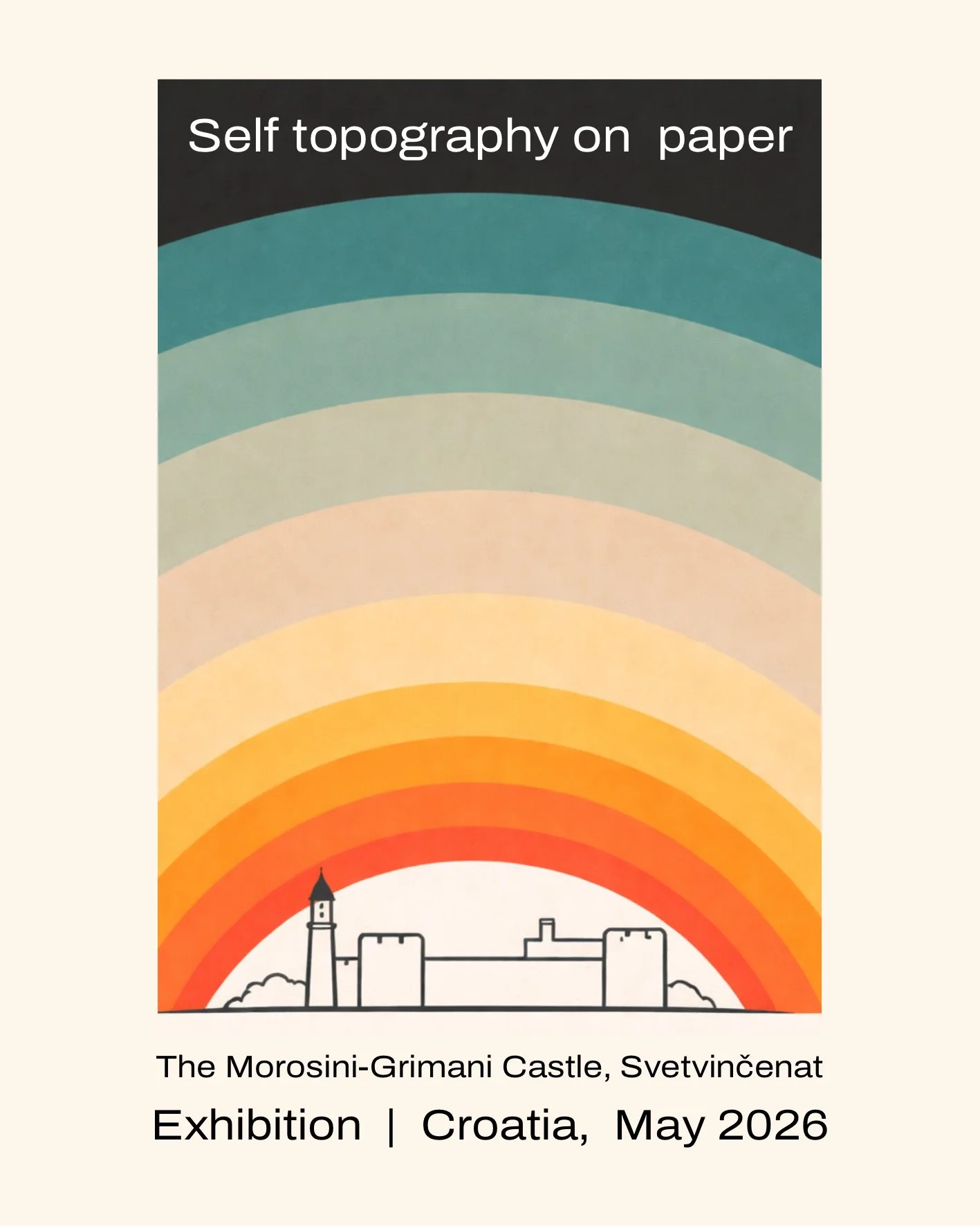
Paper may appear fragile, neutral, or secondary in the hierarchy of materials, yet it carries a powerful duality. It is surface and structure, skin and support, archive and erasure. It receives marks, absorbs pressure, folds, tears, preserves, and deteriorates. It is industrial and intimate at once. In the context of self-topography, paper becomes a site of investigation — not only something to work on, but something to think through.
Participants are invited to approach paper in the way they understand it. It may remain material — pulp, sheet, fiber, object. It may become conceptual — an idea of layering, recording, covering, imprinting. It may operate as document, as performance substrate, as installation surface, as projection field, as architectural intervention, or as spatial membrane. What matters is not a formal definition of paper, but the way each artist defines its role within their own mapping process.
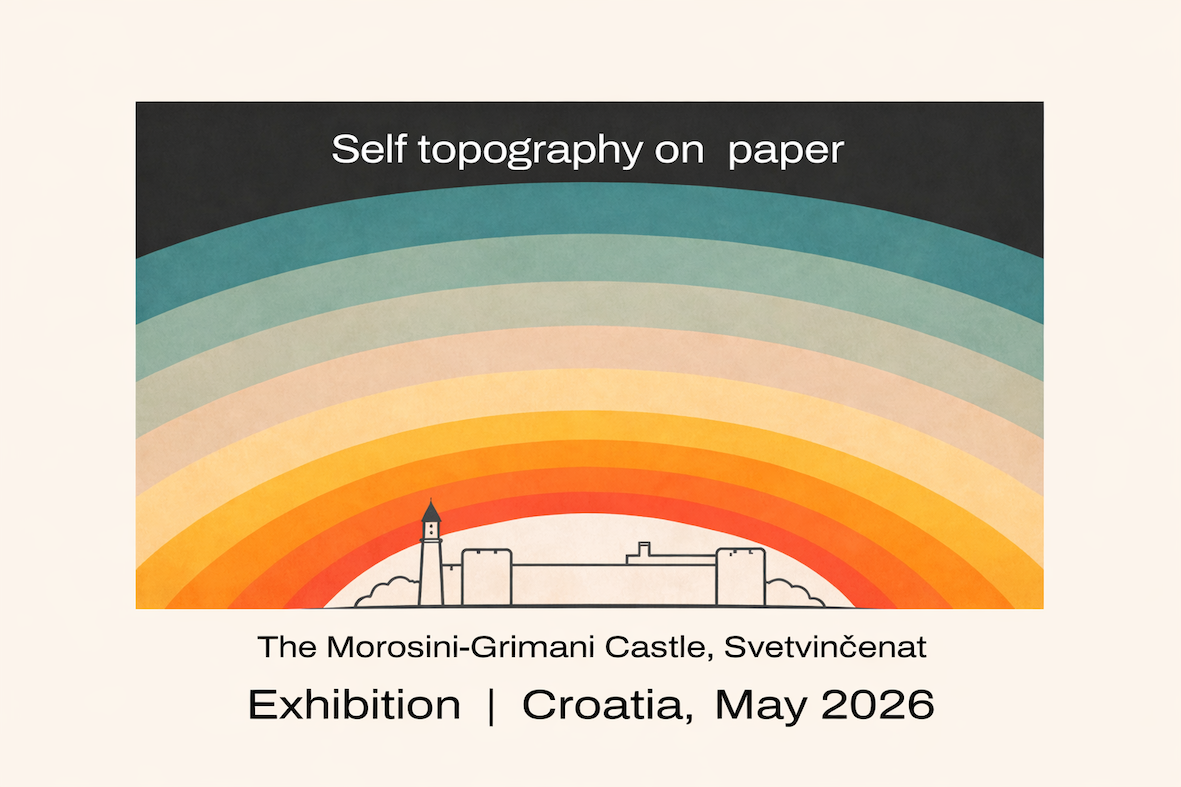
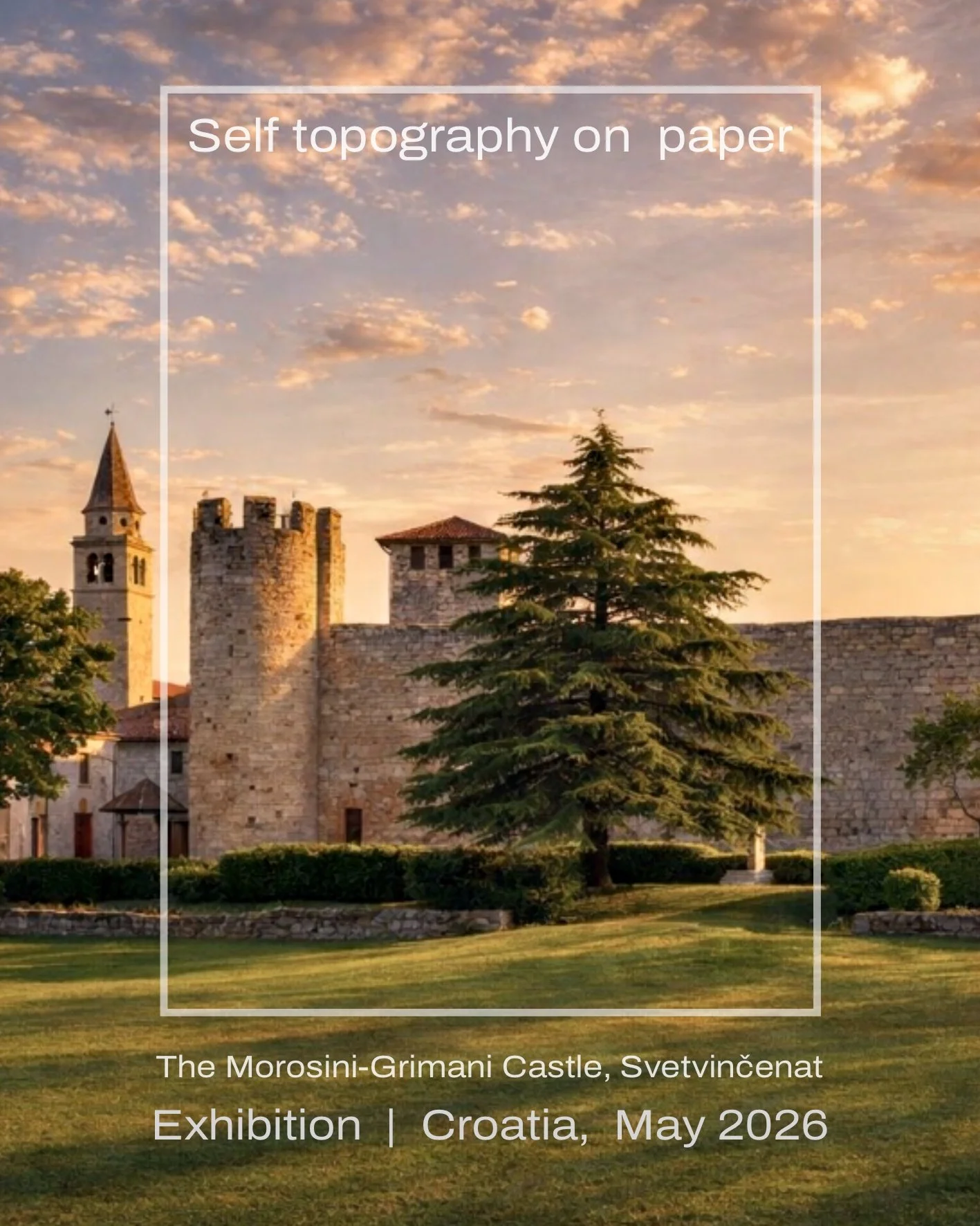
The exhibition is anchored in the Morosini-Grimani Castle in Svetvinčenat, Istria — a site shaped by centuries of political, cultural, and architectural layers. Rather than treating the castle as a neutral exhibition hall, the project approaches it as an active spatial partner. Stone walls, vaulted interiors, thresholds, corridors, and courtyards become part of the dialogue between inner terrain and outer structure.
At the same time, the exhibition is not conceived as a contained event. Self-topography, as a concept, extends outward. Works may inhabit streets, the square, transitional spaces, and ephemeral zones of the village. Performative gestures, temporary installations, video screenings onto paper objects, and spatial interventions are welcomed within this expanded approach. The village itself becomes a layered map — not as historical illustration, but as living context.
The ambition is to create a field in which individual mappings from different parts of the world can coexist. Artists bring with them distinct climates, languages, memories, political realities, and material histories. Within this shared environment, these internal geographies are placed into conversation. The exhibition becomes a temporary cartography of difference and resonance — a spatial composition of multiple self-defined terrains.
Ways to Participate
-
Artists may apply by submitting a proposal for an existing or newly developed work. Selected artists will be invited to exhibit within the castle and/or the expanded village framework. Works may be shipped and installed in dialogue with the curatorial and spatial context.
-
Artists based in Istria or surrounding regions are encouraged to engage directly with the village and its context. The exhibition welcomes works that emerge from proximity — from familiarity with the territory, its rhythms, and its daily life.
-
Artists whose work requires immersion in place may choose to spend time in Svetvinčenat in residency, developing a project in relation to the site. This option allows the mapping process itself to respond to the spatial and atmospheric conditions of the area.
Each pathway carries equal conceptual weight. What unites them is a commitment to investigate self-topography through the lens of paper.
Curatorial Intention
Self-Topography on Paper establishes a framework for investigating internal terrain. It positions self-topography as a structural inquiry: how memory accumulates, how identity shifts, how experience leaves trace, how personal history forms layers over time.
Within this framework, artists articulate their own definitions through material, gesture, and spatial decision-making. The emphasis lies not in representation, but in translation — the movement from interior structure to material presence.
The curatorial lens attends to stratification and erosion, exposure and concealment: how memory behaves as sediment, how identity fractures or shifts, what remains visible, and what recedes beneath the surface. It also attends to paper as an active register — how it carries pressure (physical, emotional, political), and how it responds to tension, repetition, folding, interruption, and exposure.
Each work functions as a proposition: a mapping of internal logic into visible form. Together, these propositions generate a field of dialogue between distinct internal terrains.
Self-Topography on Paper operates as a temporary atlas — not of geography, but of consciousness constructed through material action.
Call for Submissions:
Application Guidelines
Artists are invited to apply for inclusion in the exhibition. Submissions should include a concise written description of the proposed work, accompanied by visual documentation. Files should be kept compact for easy review. Please send all materials to info@paperlab.info no later than March 15, 2026. We look forward to receiving clearly articulated proposals for consideratio
Independent Platform
Paper Lab Berlin is an independent, self-initiated platform. It operates without institutional funding, external sponsorship, or foundation support.
All programs, exhibitions, and residencies are made possible through participant contributions. These contributions are not administrative formalities; they sustain the structure itself — the spaces, coordination, curatorial work, production logistics, and the continuity of the platform.
As an independent framework, each participation pathway may involve a financial contribution. The conditions vary depending on format, scope, and individual circumstances, and are communicated directly with selected participants.
This model allows the platform to remain autonomous — built on commitment, exchange, and mutual responsibility rather than external agendas.
Your participation does not simply occupy a space within the structure; it actively supports and maintains it.